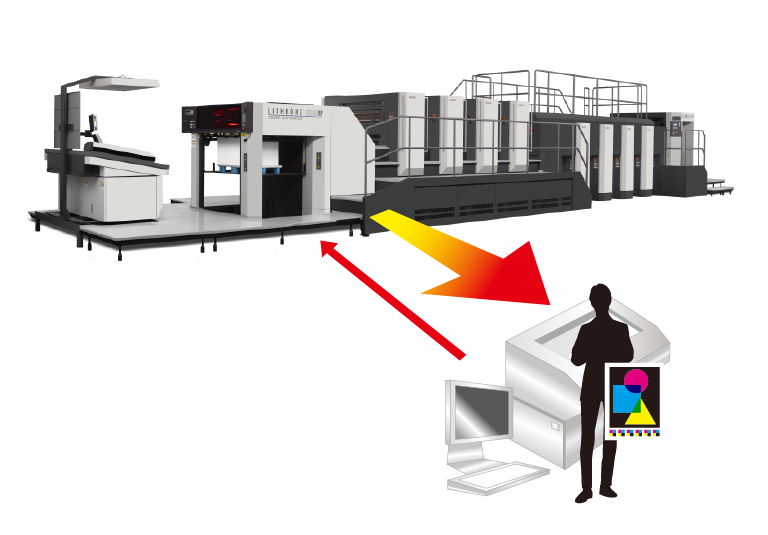
Close to Technology“Exploring Printing Technology at a World-Class Level.”
Printing Technology
Offset Printing
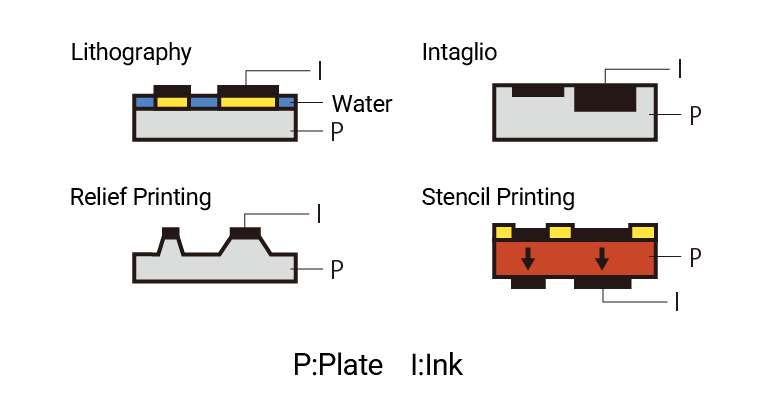
Offset printing—today’s most widely used printing method—works by first transferring ink from a printing plate to a flexible rubber blanket, and then from the blanket onto the paper.
This technique was developed as part of the evolution of “Lithographic printing.”
Compared to direct printing, offset printing provides sharper and more consistent reproduction of fine details, while also extending plate durability. For this reason, the term “Lithographic printing” is now commonly referred to simply as offset printing.
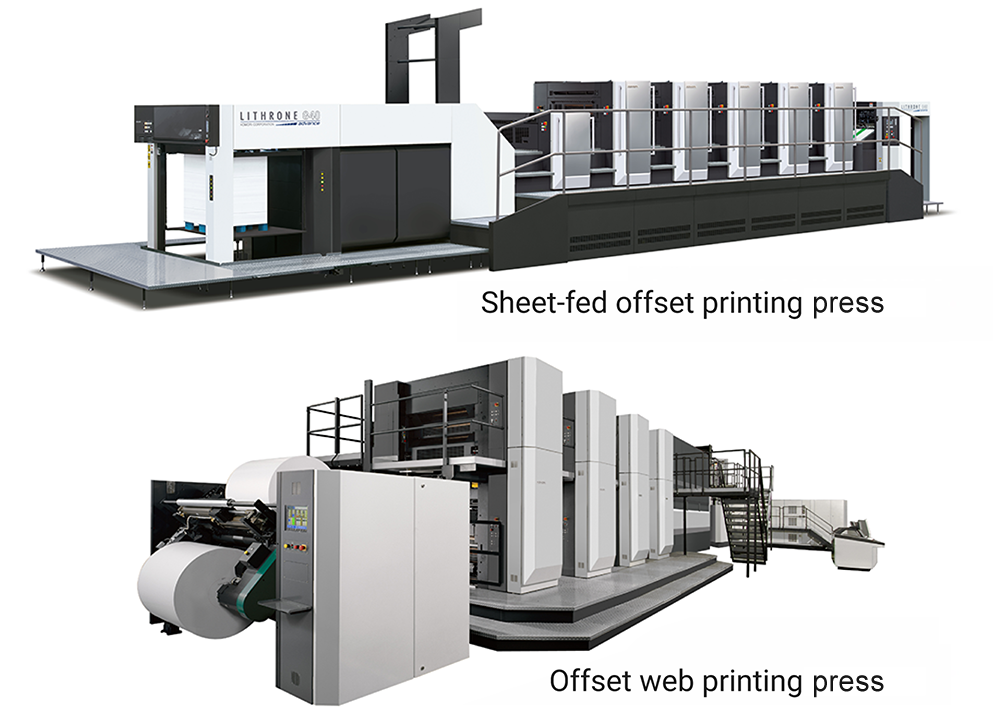
Types of Printing PressesOffset Printing presses generally fall into two categories:
Sheet-fed Printing Press and Web Printing Press
- Sheet-fed printing presses: Designed to print on individually cut sheets
- Web printing presses: Designed to print on continuous paper rolls
Traditionally, sheet-fed printing presses have been preferred for high-quality, short- to medium-run printing such as posters or catalogs. Web printing presses have been used for high-volume, high-productivity applications such as flyers or magazines.
However, advances in both hardware and software have increased the productivity of sheet-fed printing press and improved the print quality of web printing presses, making the traditional distinction between the two less clear-cut.
In terms of size, a standard four-color sheet-fed printing press is approximately 10 meters long, while a large web printing press—because it includes inline post-processing such as cutting and folding—can reach 40 meters or more.
There are also specialized presses tailored to specific applications, such as banknote printing presses and package printing presses.
Digital Printing
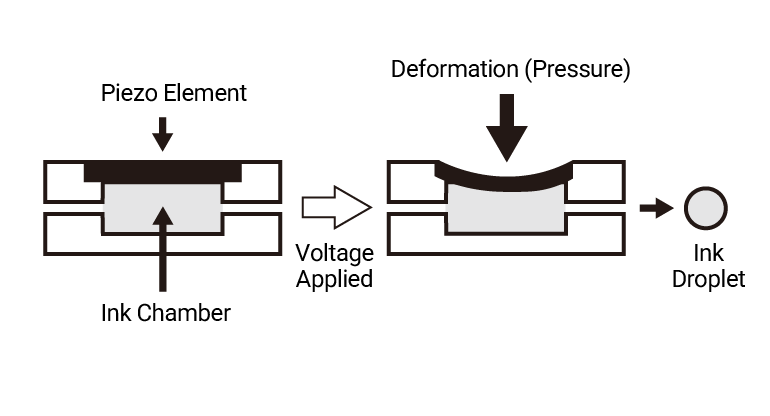
Digital printing uses laser or inkjet technology to apply image data directly onto paper—similar to how PC printers operate.
Unlike offset printing, digital printing does not require plate making, which significantly reduces turnaround time. This makes it ideal for short runs and quick delivery.
While digital printing traditionally faced challenges in cost, speed, and image quality compared to offset printing, recent advancements—such as high-resolution output and UV ink technology that allows printing on non-paper substrates—continue to expand its potential.
Color Printing
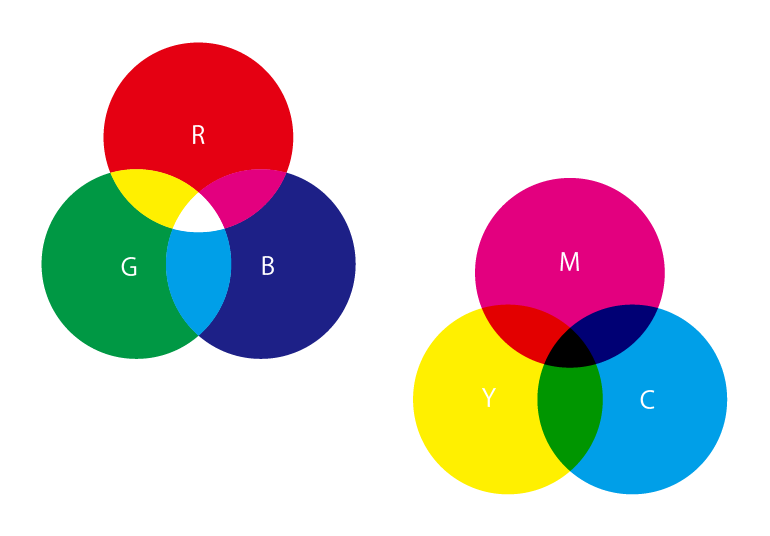
When you look closely at a television screen, you see tiny RGB (red, green, blue) dots. Printing works similarly, but the primary colors of light (RGB) are replaced with the primary colors of pigment: CMY (cyan, magenta, yellow).
In theory, mixing CMY in equal amounts should produce black. In practice, impurities in ink prevent a pure black, so printing adds a fourth color: K (black).
Black is referred to as “K” to avoid confusion with “B” for blue.
Color printing involves separating the original image into CMYK data, creating four plates, and overlaying the inks on a single sheet to reproduce the full-color image.
Prepress, Plate Making, and Printing
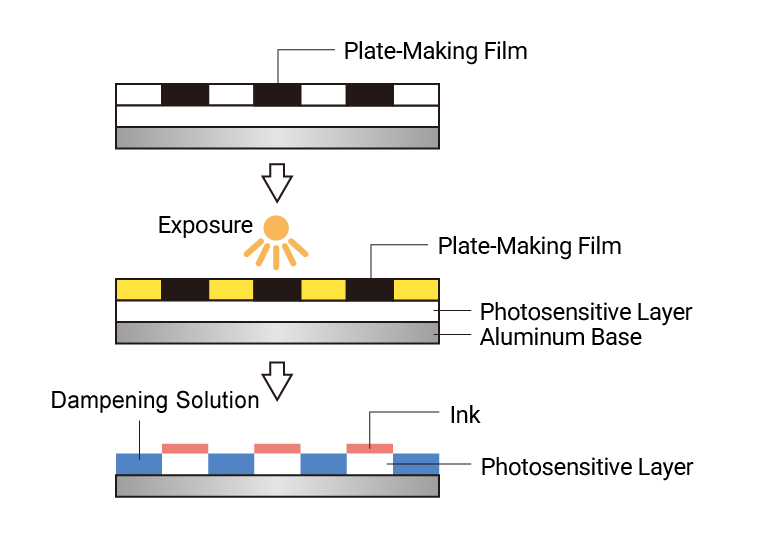
Prepress (make-up) refers to creating the films necessary for making printing plates. In color printing, four films (CMYK) are produced—today typically generated from digital DTP data.
These films are placed over PS plates (aluminum plates coated with photosensitive materials). Through exposure and development, the printing plates are created.
In printing, the ink transferred from the plate to the rubber blanket is then transferred onto the paper. Even though this process sounds simple, it requires extremely fine-tuned technology:
- Consistent ink density
- Stable printing pressure
- Precise paper feeding and timing to prevent misalignment
All of these require micron-level accuracy.
Automation & System Integration
Historically, printing relied heavily on operator experience and required extensive manual work. Today, the process is rapidly becoming automated and systematized, ensuring consistent high quality regardless of operator skill.
Komori’s commitment to automation is reflected in the following:
- AMR – Automatic Make-ready System
- PQC – Print Quality Control System
- K-LAN – Komori Local Area Network
- APC (Automatic Plate Changer)
- PDC-SX (Spectrophotometric Color Control)
- PQA-S (Print Quality Assessment)
These advancements have accelerated the development of digitally controlled printing presses.
CTP (Computer to Plate)
Computer to
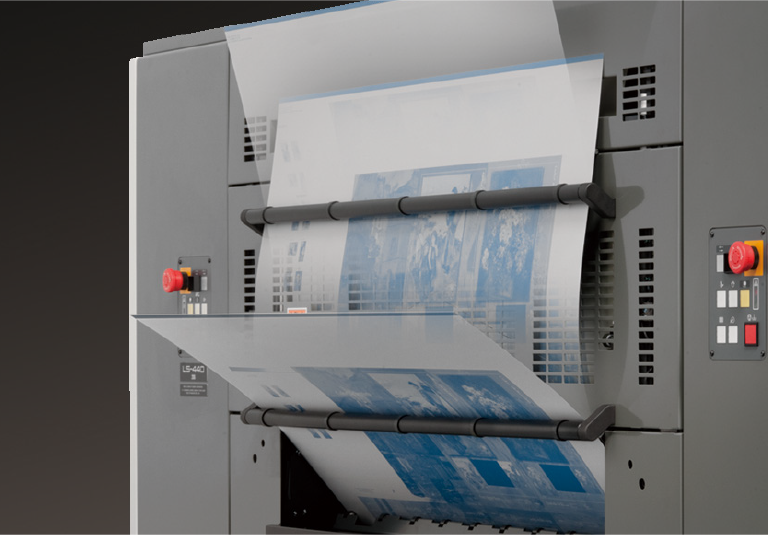
CTP (Computer to Plate) creates printing plates directly from digital data—without the need for film.
This improves efficiency by:
- Streamlining the prepress process
- Reducing material costs
- Cutting process time
- Supporting greater automation
- Improving working condition
An evolved form, Computer to Press, exposes the image directly on the printing press. This enables cost-effective short-run printing while maintaining offset-level quality, enabling true on-demand printing.
The next major milestone will be the full digitalization and networking of all printing processes.